What the Margins Carried- Secrets of Successful Speakers, lilly walters
There’s always a push to read the latest, most advanced stuff you can find. Sometimes, returning to previous successes can help us build a bridge to cross into our rainbows-and-unicorns futures.
Enter: Secrets of Successful Speakers, as written by Lilly Walters.
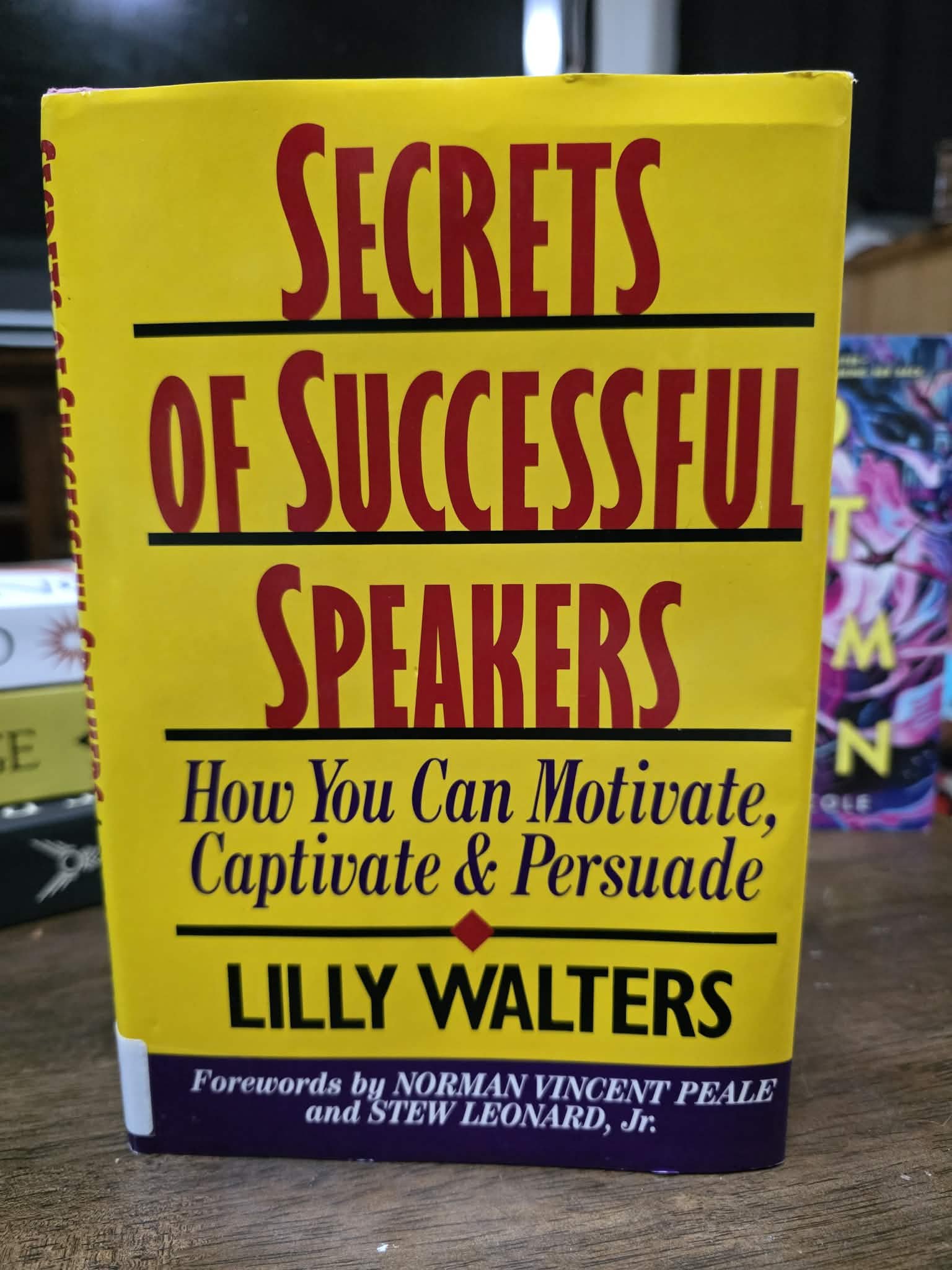
Secrets of Successful Speakers, by Lilly Walters.
My copy here is copyrighted 1993, hence throughout this book there are frequent mentions of people and works of the 80’s. I’d say the most dated info is toward the end, but it’s worth noting that, with the prevalence of internet and cellphones today, there’s more room to learn and grow, more options for tough moments.
I think one of my biggest realizations in this read was how— as someone who doesn’t offer much in way of product, but moreso in community, belonging— as I’m no educator, seeking to change people, I needed to adjust the lens of my learning. Instead of asking “What did you hope your friends would remember that would change their lives?” I could ask “When I leave the room, what do I hope is lighter for the people in it?” Or maybe “ If someone thought of me years later, what would I hope they felt allowed to do?”
This could look a number of ways, some examples include “I hope they remember what it felt like not to be judged for a moment”, “I hope they feel their instincts weren’t wrong.” This becomes your North Star, the direction for your talk, which Walters walks us into the next phase by turning this into our mission. You don’t start off with a sermon, merely a direction! “If you can’t write your mission in one sentence, you can’t speak it in an hour.”
One of the biggest, most important takeaways from this book was speaking to peoples’ needs. The example Lilly offered was talking about Customer Service to people who are struggling with housing and food. She wrote that people cannot hear you if you are speaking above their need. This talk, she says, should be slanted towards how GOOD customer service puts food on the table. This sort of goes hand-in-hand with a much later point she makes about hecklers, challengers; you’re speaking to a group of human beings. Words mean different things to different people, cultural and linguistic barriers are very real. But, someone listening when their minds are on other things is a whole different type of wall.
Didn’t think we’d be touching on Maslow’s Need Hierarchy in a book about speaking publicly, but I loved this take.
There’s all types of helpful tidbits about you and your speech, from what to wear, how to prepare— even a checklist at the end! I was shocked at how similarly So, You Wanna Model (my own debut non-fiction) was structured, from the overall flow walking you through the process, the closing chapter of actionable steps, the resources, just *chef’s kiss*.
Loved the format, especially how she touched on emergencies! I felt inspired to go through my own emergency section and add something about how you’re the authority when something goes down and you’re performing or otherwise centered.~
Lilly includes tons of quotes throughout, which offered insight into the topic at-hand. There were absolutely a few times they felt a bit too heavy, and visually appeared almost as filler. Which, this book was a VERY quick read, with me having spent only a single overnight on it. Very layman, like a friend is advising you. This was definitely a comfortable little read.
I did raise my brows at her suggestion of taking racist jokes, and replacing the “painful parts” like mentions of race, and replacing them with details about the audience. Had to set aside my feels for five seconds to consider where this sort of thing has definitely been used in marketing, modern speeches, comedy sets, etc. It’s more prevalent than you might realize at first glance!
Of course, when you cover so much info, taking your own advice and offering a gentle finish with “three main points” you’d want your audience to recall is a nice touch. Lilly slips this quick reminder in, right before the resources.
Overall, I’m a firm believer that you can take information from something, and apply it to everything else in your life. For such a quick and easy read, which I felt made an awesome starting point if you have never once been in a speaking position before— it’s worth picking up!
A book being a bit dated or even culturally-shifted (hell, malaligned entirely) has bits you can pull and take with you. There was enough casual comfort that, though there wasn’t much new info to be had for me, it was like chatting with someone familiar. I took my notes and squeezed about 2 pages’ worth from it all, which is pretty good for a review!
Thanks for reading along! Would love to hear what has helped you with your own speaking journey. Is there a book or speaker you turn to when polishing up?~